
How to Invest in Today’s Market (Australia, 2026)
High interest rates through 2024–2025, easing inflation, and ongoing volatility in 2026 create both risks and opportunities for Australian investors. The share market has shifted from interest-rate-driven moves to earnings-based growth, meaning wealth-building now requires thoughtful capital deployment.
This guide is for everyday Australians wanting to grow wealth beyond savings accounts and term deposits—not day-traders chasing quick wins. You’ll learn practical, step-by-step ways to start investing in today’s market conditions, what to invest in, and how to manage risk. This guide forms part of a broader framework for building long-term wealth — you can learn more about how investment strategies are structured in practice.
Step 1: Get Clear on Your Goals and Timeframes
Investment decisions in 2026 must start with your personal financial goals. Someone saving $40,000 for a home deposit by 2029 needs a completely different approach than someone building a retirement nest egg by age 65.
Common goals include:
Building an emergency fund
Buying a first home
Funding children’s education
Retiring earlier
Supplementing super
Timeframe categories:
Timeframe | Period | Suitable Investments |
|---|---|---|
Short-term | 0–3 years | Cash, term deposits, short-duration bonds |
Medium-term | 3–7 years | Balanced mix of growth and defensive |
Long-term | 7+ years | Higher allocation to growth assets |
Write down: (a) your main goal, (b) target amount, (c) target date, and (d) how much money you can invest monthly. These written goals will drive your later choices.
Step 2: Understand Risk, Volatility and Your Comfort Level
Investment risk means the chance your portfolio falls in value or doesn’t meet your goal. The 2020 COVID crash and 2022–2024 rate rises are fresh reminders that markets can fall 20–30% in a single year—then recover over longer periods.
Try the “sleep-at-night” test: if your portfolio dropped 20% this year, would you sell, hold, or buy more shares? Your honest answer reveals your risk appetite.
Basic risk profiles:
Conservative: 25–35% growth assets, 65–75% defensive
Balanced: 50–60% growth, 40–50% defensive
Growth: 70–80% growth, 20–30% defensive
High growth: 85–95% growth, 5–15% defensive
Even term deposits carry risk—if inflation runs at 3% and your deposit earns 4.5%, real returns are modest.
Step 3: Know Your Investment Options in Today’s Market
Investors choose between defensive assets (cash, bonds) and growth assets (shares, property, diversified ETFs), each affected differently by 2024–2026 conditions.
Cash and term deposits: Relatively low risk with rates still higher than pre-2022, but often below long-term share market returns after inflation and tax.
Bonds: Government and corporate bonds provide fixed income. The 2022–2024 rate hikes pushed down bond prices, but yields in 2026 may be more attractive.
Shares: Buying ownership in companies on the Australian Securities Exchange and overseas markets. Growth potential plus volatility, with dividends and franking credits enhancing after-tax returns for Australian residents.
Exchange traded funds and managed funds: Diversified exposure through vehicles like an ASX 200 ETF or global index funds, offering lower-cost access than individual stock picking across different industries.
Property: Direct residential investment or listed property (REITs). Rising rates since 2022 mean higher entry costs and mixed outlooks.
Avoid speculative assets like unresearched penny stocks or hype-driven investments as core portfolio holdings.
Defensive vs Growth Investments in Practice
Defensive investments (cash, high-grade bonds) prioritise capital preservation. Growth assets (shares, property) drive long-term capital growth but with higher volatility.
Example mixes during a 20% share market drop:
Allocation | Portfolio Decline |
|---|---|
Conservative 30/70 | ~6% |
Balanced 60/40 | ~12% |
Growth 80/20 | ~16% |
In 2026, many investors are reconsidering their mix as cash rates have risen while share prices have adjusted.
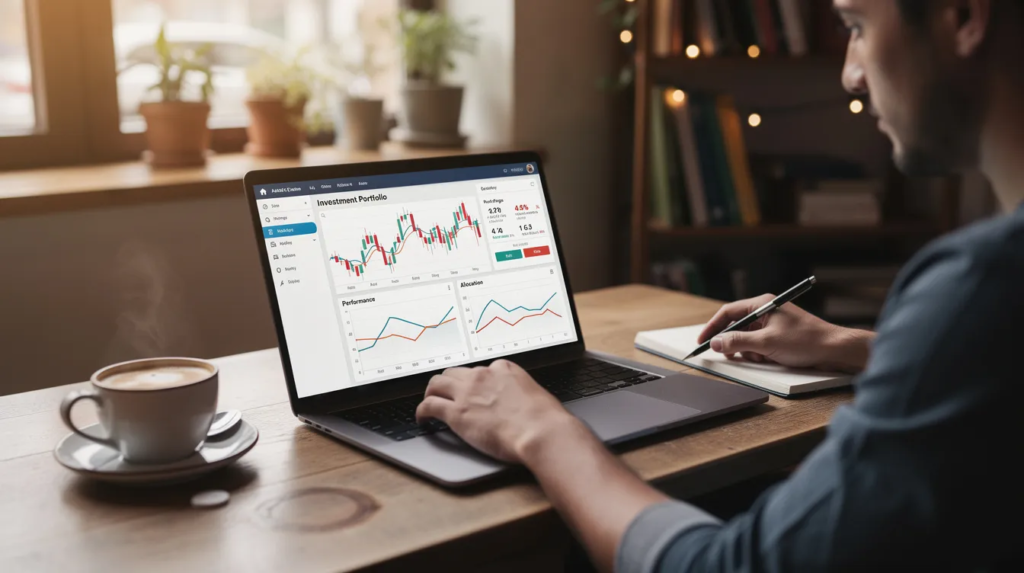
Step 4: Decide How You’ll Invest – Directly or Through Funds
You can choose investments yourself (direct) or use diversified products (indirect).
Direct investing: Opening a broker account to buy and sell individual ASX shares or ETFs. You control what’s in your portfolio but need time to research a company’s earnings and monitor holdings.
Indirect investing: Using managed funds, index funds, or multi-asset ETFs that automatically spread money across many companies. Many new investors start with low-cost diversified ETFs rather than picking single stocks.
Investing Inside vs Outside Superannuation
Most Australians are already investing through compulsory super contributions. Key differences:
Super: Tax-effective (contributions taxed at 15%), but funds locked until preservation age
Non-super: Flexible access anytime, but paid tax at your marginal rate
Younger investors often focus on both: maximising super settings for long-term wealth while building a separate portfolio for medium-term goals.
Step 5: How to Start – From Your First $1,000 to a Regular Plan
Common Australian online brokers have minimum trade sizes around $500–$1,000. Some micro-investing apps allow lower entry points.
Practical example: Start with $1,000 in a diversified ETF, then add $200–$500 per month via automated transfers from your bank account. This dollar-cost averaging approach means you buy more units when prices are lower and fewer when prices are higher—smoothing out volatility.
Compare brokerage fees carefully. A $5–$10 fee matters less on a $5,000 investment than on a $500 one. Set up automatic investment plans aligned to payday so you invest consistently through market ups and downs.
Building an Emergency Buffer Before Investing
Before taking on market risk, maintain 3–6 months of essential expenses in a high-interest savings account. If monthly spending is $3,000, aim for $9,000–$18,000 accessible. This buffer reduces pressure to sell investments during downturns.
Step 6: Choosing What to Invest in – A Simple Framework
Picking investments in 2026 should be systematic, not based on headlines about AI booms or New York Stock Exchange records.
Simple decision sequence:
Choose asset mix (growth vs defensive allocation)
Choose markets (Australia vs global, including exposure to the York Stock Exchange through global ETFs)
Choose vehicles (index ETFs vs active funds vs individual stocks)
Many long-term investors use diversified core holdings like low-cost index ETFs tracking the ASX 200 and global indexes. Prefer simple, low-fee options over complex products you don’t understand. Past investment returns from 2013–2023 aren’t guaranteed to repeat.
Researching Investments Without Getting Overwhelmed
Focus on core sources: product disclosure statements, fund fact sheets, and reputable education sites. Scan key metrics: fees (management expense ratio), diversification, and long-term performance vs benchmark.
Avoid relying on “hot tips” from unpaid influencers or unlicensed advice, especially when they promote leverage. Check any adviser is registered with ASX Limited or appropriate regulators.
Step 7: Managing Risk in a Volatile World
Current global uncertainties—geopolitics, inflation, interest rate shifts—require risk management rather than prediction.
Diversification means spreading across:
Asset classes (cash, bonds, shares, property)
Geographies (Australia, US, emerging markets)
Sectors (banks, resources, healthcare, technology)
Don’t put all your money in one stock or sector. Tech sector crashes and resource downturns have hurt concentrated portfolios. Keep speculative investments small, review allocations annually, and decide your risk tolerance before share trading begins. What is diversification in investing.
Time in the Market vs Timing the Market
Many of the best days in markets occur close to the worst days. An investor who stayed invested through the 2020 COVID crash recovered losses within months. One who sold at the bottom and waited too long to re-enter missed the recovery entirely.
A disciplined plan with regular contributions beats tactical guessing for most other investors.

Step 8: Taxes, Record-Keeping and Avoiding Scams
Investing happens within a tax framework. Ignoring tax implications can erode returns.
Key tax concepts:
Capital gain tax on profits when selling shares (50% discount if held over 12 months)
Dividends taxed as income, with franking credits reducing your tax bill
Keep organised records of buys, sells, and distributions
Scam warning signs:
Guaranteed high returns
Pressure to act quickly
Overseas or unlicensed entities
Requests for remote access or sending foreign currency to unknown wallets
Check that any platform or adviser is appropriately licensed. You can verify using government registers.
Step 9: Building a Long-Term Investing Habit
Investing is an ongoing habit, not a one-off action. Set a review rhythm—once or twice yearly—to check progress toward goals.
Rebalancing: If shares outperform and your 60/40 allocation drifts to 70/30, sell a little of what’s grown and top up what’s lagged. This keeps your portfolio aligned with your chosen risk profile.
Personal rules to avoid emotional decisions:
48-hour rule before large changes
Only change strategy based on life events, not headlines
Continue dollar-cost averaging through volatility
Value continued education through quality books and courses. As a market participant, your knowledge compounds alongside your investments.
How Money Path Can Help You Invest in Today’s Market
Money Path is an educational partner for Australians who want to invest directly and confidently—not a trading platform or product provider.
Money Path helps translate high-level goals into concrete, time-bound investment plans suitable for 2026 conditions. Complex topics—asset allocation, choosing between a listed company and diversified funds, understanding tax on dividends—are broken into practical learning modules.
Compare different approaches (direct shares vs ETFs, super vs non-super) and understand trade-offs in risk, fees, and flexibility. Money Path emphasises disciplined, long-term investment strategies and sensible risk management rather than speculation.
Frequently Asked Questions About Investing in Today’s Market
Q1: Is now (2026) a bad time to start investing? There’s never a perfect time. Starting small, diversifying across asset classes, and investing regularly manages timing risk. Those who started during the 2020 crash ended up well ahead.
Q2: Should I wait until interest rates fall? Markets move in anticipation. By the time cuts are obvious, share prices have often already risen. Phasing in gradually beats waiting for perfect clarity.
Q3: How much do I need to start? Standard brokers require $500–$1,000; some apps accept less. Consistency matters more than starting with more money in one lump sum.
Q4: Pay down mortgage or invest? Mortgage repayment gives a guaranteed “return” equal to your interest rate. Investing offers higher potential returns with more risk. Many blend both based on their financial situation and time horizon. Professional advice can help with complex trade-offs.
Q5: How do I cope when markets fall? Focus on long-term goals. Revisit your written plan. View downturns as opportunities to buy at a higher price later—or a lower one now. Limit checking price charts daily.
Q6: Do I need professional advice? Consider it for complex situations, large balances, or nearing retirement. Money Path’s education helps you get more value from any advice—whether you invest in shares independently or through a good company adviser acting as a clearing participant or settlement participant.
Start your investment journey today. Write down your financial goals, choose diversified low-cost options, and invest regularly through market cycles. With discipline and education, you can build lasting wealth—not through timing, but through time.