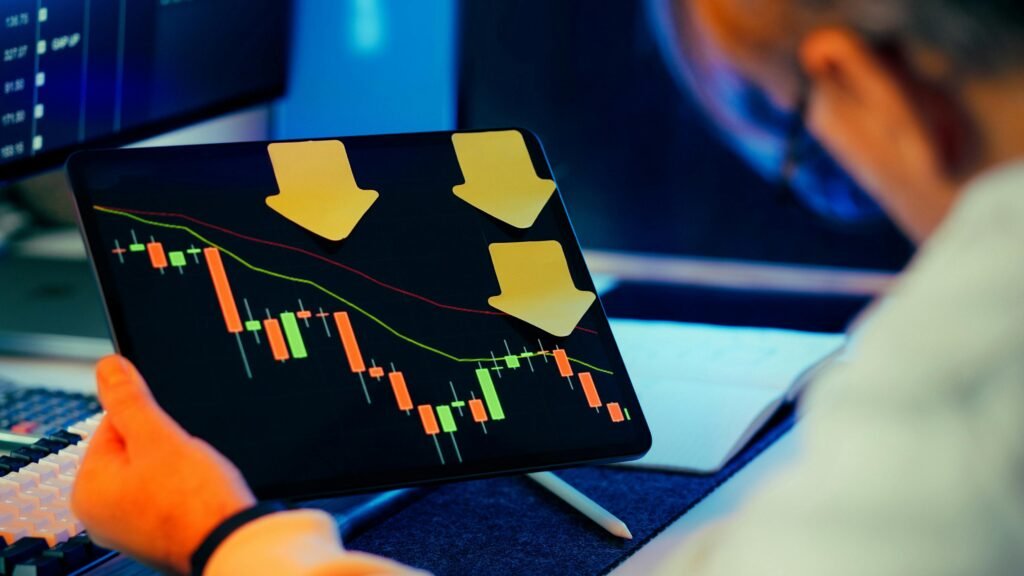
When the stock market fell sharply in March 2020, millions of Australian investors watched their portfolio balances plunge in real time. The experience raised a question that many had never seriously considered: what actually happens to your shares when prices collapse?
Market crashes can have ripple effects across the world, impacting economies far beyond just the local market. Events in the world’s largest economy, such as the US, often influence global markets and contribute to widespread volatility.
This article breaks down the mechanics of a market crash, explains what changes (and what doesn’t) for shareholders, and highlights the key financial planning considerations that matter during periods of extreme volatility. These decisions are typically guided by a broader investment framework — you can learn more about how investment strategies are structured in practice.
Quick Answer: What Actually Happens to Your Shares in a Crash?
During a stock market crash, share prices can fall 20–50% or more within days or weeks. However, the number of shares you own does not change unless you actively sell them. Your ownership remains intact—what changes is the price that buyers are willing to pay for those shares at that moment.
When we say value “vanishes,” we mean the last traded price drops sharply. This is often referred to as ‘lost value’—a decrease in the market capitalization of shares. Money doesn’t literally leave the banking system or disappear from your broker account. Instead, the market’s collective valuation of those shares—reflected in the marginal price between the last buyer and seller—plummets.
Consider a concrete example: the ASX 200 fell approximately 37% between February and March 2020. An investor holding a diversified Australian share portfolio valued at A$100,000 in February would have seen that portfolio fall to roughly A$63,000 by late March. Yet they would still own the exact same number of shares.
This introduces a crucial distinction:
Paper loss (unrealised): Your portfolio shows A$63,000 instead of A$100,000, but you haven’t sold
Realised loss: You sell at A$63,000, locking in the A$37,000 loss permanently
The perceived disappearance of money during a crash is primarily a result of changing investor perceptions and market dynamics, rather than an actual loss of capital.
In regulated markets like Australia’s ASX and Chi-X, shares are typically held under CHESS (Clearing House Electronic Subregister System) or via custodians under strict client asset rules. A crash in stock prices is fundamentally different from a broker or bank failure—your shares remain protected even when their market value drops.
Successful investors learn to manage their emotions and stick to their long-term investment strategies, even during market downturns. Fear and greed may control our emotions, but they don’t have to control our investing behavior.
The rest of this article covers why prices crash, what happens inside companies and markets, and how investors can manage risk and make informed decisions during market downturns.
How Market Crashes Work: Prices, Not Shares, Collapse
A market crash is a sudden, dramatic decline of at least 10% in major stock indices within days, often reaching 20–30% over weeks. These events form part of broader market movements — particularly when understanding how market cycles, including bull and bear markets, evolve over time. These major declines can have a profound impact on investor confidence and market stability. Critically, the actual number of outstanding shares usually stays the same during this period.
Share prices are set at the margin—determined by the last transaction between a willing buyer and seller. In normal conditions, these marginal trades adjust gradually. During a crash, far more investors wish to sell than buy at yesterday’s prices, forcing prices downward rapidly to find new equilibrium levels.
Notable crashes illustrate the severity:
Black Monday (19 October 1987): The Dow Jones Industrial Average fell 22.6% in a single day
COVID-19 crash (March 2020): The ASX 200 and S&P 500 triggered multiple “limit down” circuit breakers within weeks
2025 tariff-driven sell-off: Trade policy uncertainty sparked rapid market downturns across global financial markets
Stock market crashes are driven by panic selling and underlying economic factors, and often result in significant losses of paper wealth. Crashes often follow speculation and economic bubbles. Economic bubbles occur when excessive optimism leads to inflated stock prices that do not match intrinsic values, often resulting in a crash when the bubble bursts.
Market indices like the ASX 200, S&P 500, and Nasdaq Composite aggregate individual share price moves across the broader share market. When indices experience a significant drop, index ETFs and superannuation fund balances fall proportionally. This creates a direct mechanical link between index movements and retail investor balances, and a significant drop can strongly impact investor sentiment.
While quotes change second by second, underlying business assets—factories, intellectual property, customer bases—don’t move that fast. The crash reflects an abrupt change in sentiment and risk pricing, not necessarily a fundamental deterioration in business value.
Why Prices Plunge So Fast: Supply, Demand and Panic
The core mechanic is simple: more people wanting to sell stocks than buy at current prices forces prices down. But several factors can turn a steady decline into a sharp drop.
Algorithmic trading and forced selling cascade:
Algorithmic systems programmed to sell when prices fall can execute massive volumes instantaneously. Margin calls force leveraged investors to liquidate positions when collateral values breach maintenance thresholds. Stop-loss orders execute en masse, adding selling pressure. When large institutional investors sell substantial portions of their holdings, it can increase supply in the market and drive down prices.
Consider this chain reaction: a leveraged investor in US technology stocks during 2020–2022 faces margin calls as stock prices fell. They’re forced to dump shares into an already-falling market. This further depresses prices, triggering additional margin calls for other investors, creating a self-reinforcing cycle. This is why maintaining a disciplined approach is critical — particularly when considering why long-term investment strategy matters more than short-term market timing. Certain trading activities, such as day trading or high-frequency trading, represent only a small fraction of total market volume and have limited impact on overall market dynamics.
Herd behaviour and loss aversion:
Research shows that panics leading to crashes stem from dramatic increases in imitation among investors. Loss aversion—where losses feel roughly twice as painful as equivalent gains—drives panic selling. When many investors closely follow each other’s cues, fear spreads rapidly.
Circuit breakers as a response:
Modern markets implement trading halts to slow panic. The S&P 500 uses three levels: 7% decline triggers a 15-minute halt, 13% triggers another halt, and 20% halts trading for the day. The ASX similarly implements intraday volatility halts. These mechanisms don’t prevent crashes—they slow the pace.
What Happens to Individual Shares You Own?
Each listed company reacts differently during a market crash. Some shares may fall 60% or more, while defensive stocks in essential services might decline only 10–20%. This highlights the importance of portfolio construction — particularly when considering how diversification helps manage risk across sectors and markets. Consumer staples and utilities often hold up better than cyclical sectors.
The number of shares on issue typically doesn’t change during the acute crash phase. What changes is the market’s estimate of future earnings, risk, and required return.
Concrete example: You own 1,000 shares in an ASX-listed bank at A$30 each, totalling A$30,000. During the COVID-19 crash, the share price falls to A$18. Your portfolio value drops to A$18,000—a paper loss of A$12,000 or 40%. But you still own exactly 1,000 shares.
Corporate actions may follow in subsequent months:
Dividend cuts to preserve cash
Buyback program suspensions
Emergency capital raisings at steep discounts
For Australian investors, these changes flow through to superannuation balances, managed funds, ETFs, and listed investment companies.
Paper Losses vs Realised Losses
An unrealised (paper) loss exists when the market price of your holding falls below your purchase price, but you haven’t sold. A realised loss is locked in only when you actually sell at that depressed price.
Timeline comparison:
Investor A (panic seller):
January 2020: Bought S&P/ASX 200 ETF at A$6.80 per unit (10,000 units = A$68,000)
March 2020: Value falls to A$4.28 per unit (A$42,800)
Sells in panic, realising A$25,200 loss
Late 2021: Those same units now worth A$68,000+—but Investor A missed the recovery
Investor B (patient holder):
January 2020: Bought same ETF at A$6.80 per unit
March 2020: Sees paper loss of A$25,200 but doesn’t sell
Late 2021: Value recovers to A$68,000 and continues appreciating
Result: No realised loss, full participation in recovery
Historically, markets have always eventually recovered and reached new highs after crashes. By holding through downturns, long term investors have benefited when the market recovered.
For Australian investors, realised capital losses may offset capital gains. However, by selling during a crash, you forfeit participation in future recovery gains—which historically have been substantial.
From a financial planning perspective, it’s important to maintain a long-term view and avoid panic selling during market downturns. Long term investors are typically able to weather market downturns, as they focus on long-term growth and are less affected by short-term volatility.
Dividends, Buybacks and Capital Raisings in a Crash
Crashes cause boards to re-evaluate cash flows and capital management, directly affecting shareholder returns.
During the 2008–2009 Global Financial Crisis and COVID-19 2020 crash, numerous ASX-listed companies cut or suspended dividends. Australian banks—traditionally high dividend payers—faced pressure to retain capital. Airlines, hospitality companies, and retailers suspended dividends as cash became critical for survival.
Buyback programs are typically paused during crashes to preserve liquidity. In rare cases, management may accelerate buybacks if they believe the stock is trading at an extreme discount to intrinsic value—though this is uncommon when boards face pressure to preserve cash.
Deeply affected companies may run emergency equity raisings at steep discounts. Airlines raised capital at significant discounts during COVID-19. These raisings dilute existing holders who don’t participate: new investors own a larger percentage of the company for less capital.
What Happens Inside Companies and Markets During a Crash?
Behind the scenes, listed companies, brokers, exchanges, and regulators respond to extreme volatility with intensified activity.
Boards and executives move into crisis-management mode: updating cash-flow forecasts, revising risk assessments, and scenario planning for prolonged economic downturn. Risk committees meet with increased frequency, reassessing liquidity, debt covenants, and capital management policies.
Trading volumes spike dramatically on exchanges like ASX, Chi-X, NYSE, and Nasdaq. This creates operational pressure on brokers, custodians, and registries to clear and settle trades accurately. During March 2020, systems were tested to near capacity.
Information flows increase rapidly: continuous disclosure announcements, profit downgrades, and regulatory guidance from market authorities and central banks. For financial services firms, surging client activity and unusual transaction patterns can trigger enhanced monitoring and reporting obligations.
Risk Management, Leverage and Forced Selling
Leverage is often the amplifier that turns a normal market correction into a sharp crash. Margin loans, derivatives exposure (CFDs, options, futures), and securities-backed lending magnify the impact of price falls.
How forced liquidation works:
When an investor borrows money to purchase securities, the lender sets a maintenance margin threshold (typically 25–30% of market value). If collateral value falls below this threshold, the lender issues a margin call. The investor must either deposit additional cash or face forced liquidation.
Example: An investor borrowed A$50,000 to purchase A$100,000 of shares (50% leverage). The maintenance margin is 30%. If the market falls 40%, shares are worth A$60,000, and equity is A$10,000 (16.7%)—well below the 30% threshold. The broker forces liquidation, often at worse prices than the marked-to-market value.
During a crash, risk departments in brokers and banks tighten limits, raise haircuts, and restrict new leveraged positions. These risk actions are logged and auditable, intersecting with regulatory expectations around conduct and client suitability.
Trading Halts, Circuit Breakers and Market Safeguards
Modern markets use multiple protections to prevent disorderly trading during crashes. These safeguards were introduced following Black Monday 1987, when the absence of such protections allowed a 22.6% single-day decline. Rising interest rates, as part of central bank monetary policy, can also influence market behavior and contribute to the need for trading halts by increasing borrowing costs and shifting investor preferences during periods of market stress.
Index-level circuit breakers:
Level | S&P 500 Decline | Action |
|---|---|---|
Level 1 | 7% | 15-minute trading halt |
Level 2 | 13% | 15-minute trading halt |
Level 3 | 20% | Trading halted for the day |
The ASX implements similar mechanisms with intraday volatility halts. | ||
Company-specific halts: |
Individual companies may request trading halts during extreme uncertainty—typically pending capital raisings or major announcements. During COVID-19 March 2020, many exchanges globally triggered limit-down halts repeatedly within a short period.
These mechanisms serve regulators’ mandate: preserving fair and orderly markets while still allowing price discovery and liquidity.
Behaviour, Strategy and Governance: How Investors Should Respond
Fear and herd mentality dominate investor psychology during crashes. For anyone interested in personal finance, understanding how to manage your money and investments during a market crash is foundational. The temptation to abandon long-term strategy during steep drawdowns is powerful—and often counterproductive. Investors often worry that a stock market crash will lead to a recession, which is indicated by declining GDP levels and rising unemployment.
For many investors, including trustees and directors, the priority is avoiding forced selling and maintaining sufficient liquidity and diversification. It is important to invest with discipline during downturns, focusing on long-term goals rather than reacting to short-term volatility. Some investors may consider opening a long position in undervalued stocks, aiming to benefit from potential market recoveries while managing risk appropriately. Others may seek out safe havens—assets or strategies that can help preserve capital during periods of extreme volatility. Stay invested through market moves rather than trying to time exits and re-entries.
Younger investors—Gen Z and Millennials experiencing their first serious bear market—may be more vulnerable to sensationalist headlines. Historical context helps: the ASX and S&P 500 eventually recovered and set new highs after the GFC, COVID-19, and the 2025 tariff shock. Markets rallied following each period of economic uncertainty.
Institutional and wholesale clients should maintain documented investment policies and risk appetites, especially where scrutiny is high.
Practical Portfolio Steps During and After a Crash
Note: This is not personal financial advice, but outlines general principles investors and financial planners consider.
Key actions to consider:
Rebalancing toward target asset allocations (selling assets that held up to buy assets at lower prices)
Reviewing concentration risk across sectors and individual holdings
Assessing exposures to highly leveraged or structurally challenged sectors
Maintaining sufficient cash reserves as a buffer
During market rebounds, positive news and increased investor demand can drive higher prices, especially in sectors that recover quickly.
Dollar-cost averaging example:
An investor who invested A$1,000 monthly in an S&P 500 index fund from 2007 through 2017 purchased shares at high prices (2007–2008), at crash prices (2008–2009), at recovery prices (2009–2016), and at new highs (2016–2017). The average purchase price was well below the 2017 value, demonstrating how regular investing through the GFC rewarded patience. It may take a few months for markets to recover after a decline, so investors should be prepared for some volatility during that period.
Institutional investors should align tactical moves with their documented investment strategy and record rationales for audit and legal defensibility.
Historical Market Crashes: What They Tell Us About Shares
Looking at past notable crashes clarifies how far shares can fall, how long recovery takes, and how regulation has evolved. The New York Times has documented these events, shaping public perception and providing detailed accounts of investor reactions and market turmoil.
Crash | Peak-to-Trough Decline | Recovery Timeline |
|---|---|---|
1907 Panic | ~50% | 1–2 years |
1929 Wall Street Crash | ~79% | 4+ years |
1987 Black Monday | 22.6% (single day) | Months |
2000–2002 Dot-com bust | ~78% (Nasdaq) | Years; many companies never recovered |
2007–2009 Great Recession | ~57% (S&P 500) | ~4 years to regain highs |
2020 COVID-19 | ~37% (ASX 200) | ~4 months |
In each case, diversified equity markets eventually recovered—but many individual companies never regained prior peaks. During the dot-com bust, thousands of internet companies fell to zero. During the financial crisis, some financial institutions wiped out equity holders entirely. Short selling was widely used by investors to profit from falling prices, especially during the Great Recession. | ||
Each major decline prompted regulatory and risk-management changes: circuit breakers after 1987, strengthened capital requirements after 2008, and enhanced market safeguards across cycles. |
The Panic of 1907 was caused by a group of investors manipulating the share price of the United Copper Company, leading to panic selling. Bank runs played a critical role, as widespread withdrawals from banks like the Knickerbocker Trust triggered chaos and contributed to the crisis.
The Wall Street Crash of 1929 was characterized by excessive optimism and speculation in the stock market. The crash marked the beginning of the Great Depression.
The 1987 crash, known as Black Monday, was influenced by program trading and psychological feedback loops among investors.
The 2008 financial crisis, also known as the Great Recession, began with a sharp decline in housing prices and widespread defaults on subprime mortgages. The sharp decline in housing prices triggered a broader collapse in financial stability, leading to a global economic downturn.
Lessons for Today’s Investors
Key lessons from historical crashes:
Markets can fall further and faster than most models predict
Recovery is common for diversified portfolios but uneven across sectors and companies
Leverage and poor governance magnify damage—losing money accelerates when positions are forced closed
Robust risk management matters most under stress
These historical reforms connect directly to current financial planning best practices. The significant decline in asset prices during crashes tests both investment resilience and investor discipline.
Sophisticated investors should view crashes as both a financial risk and an opportunity to review their long-term strategy.
How Money Path Can Help
Navigating the complexities of stock market crashes and managing your investments during volatile periods can be challenging. Money Path offers expert financial advice and tailored strategies to help individual investors and institutions protect and grow their portfolios.
With Money Path, you can benefit from:
Comprehensive risk assessment and portfolio analysis to identify vulnerabilities and opportunities
Guidance on diversification, asset allocation, and defensive stock selection to mitigate downside risks
Support with implementing disciplined investment strategies such as dollar-cost averaging and long-term planning
Assistance in managing leverage and margin calls to avoid forced selling during downturns
Up-to-date market insights and education to help you make informed decisions amidst economic uncertainty
Personalized financial planning that aligns with your goals, risk tolerance, and time horizon
By partnering with Money Path, investors gain confidence to stay the course during market turbulence and capitalize on recovery opportunities, ensuring a resilient investment journey.
This article aims to help investors understand what happens to shares during a market crash and how to respond wisely. For personalised advice, consult a qualified financial planner who can tailor strategies to your individual circumstances.